

My 10 Favorite Places in Switzerland
I just spent spring of this year exploring Switzerland for three full months, from late March through late May. I enjoyed a series of pet sitting and work exchange gigs all over the country. I also visited 50+ luxury hotels in various cities and towns throughout Switzerland, on assignment. I wrote about my three-month explorations here
Although I did not get to visit every famous or jaw-dropping place in Switzerland, I did get to visit a majority of them. I went to all the big cities: Geneva, Zurich, Bern and Basel. I also visited most of the famous smaller cities and towns, including Lucerne, Interlaken, Montreaux, Lausanne and Neuchatel, along with some perhaps less famous towns, like Sion, Chateau D’Oex, Gruyere, Gstaad and Zermatt.
I walked along the shores of most of Switzerland’s famous large lakes: Lakes Geneva, Zurich, Neuchatel, Thun and Lucerne. I also rode trains along the shores of several other lakes.
I rode through many beautiful valleys, cycled through rolling farmlands, hiked in beautiful forests and open meadows, gazed at dozens of high jagged Alps mountains and strolled along several major & minor rivers: the Rhine River in Bern, the Rhone in Geneva and Sion, the Aare in Geneva, the Limmat in Basel, the Reuss in Lucerne and the Saane in Chateau D’Oex.
I’d say that overall I got just about the full Swiss experience, apart from skiing and eating fondue.
Reflecting on my wonderful spring in Switzerland, I’ve come to identify my 10 favorite places in the country. Here they are:
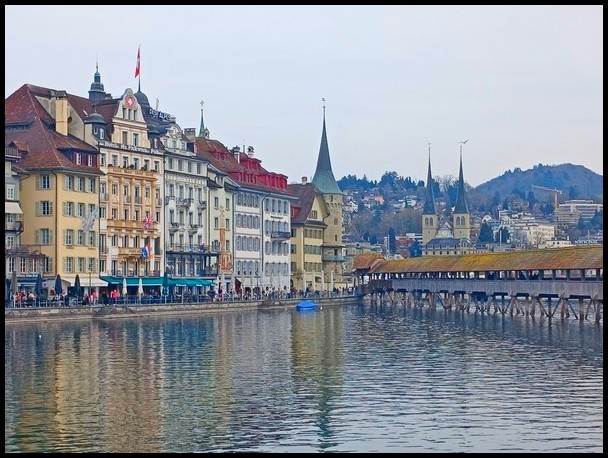
1. Lucerne
Lucerne is a small famous historic lakeside town in central Switzerland. It’s set on the shores of a large western finger of Lake Lucerne, at the point where the River Reuss flows into the lake. Thus, the compact city is beautified by both riverside and lakeside shores.
Lucerne also faces stunning jagged mountains to the south and across the lake to the east. The natural setting is simply spectacular.
If I had to pick just one top favorite place in Switzerland, it would be Lucerne. The architecturally-rich historic buildings, homes and churches are spectacular. A zig-zag Medieval covered wooden bridge crosses the Reuss River. High snow-capped jagged peaks soar around the city and across the lake.
Lucerne is compact enough to access everything on foot. But a fleet of colorful electric trolleys also run throughout the city. Its small compact size make it easy to enjoy.
Actually, Geneva and Zurich have more or less the same natural setting as Lucerne. They’re all set on lake shores at a point where a river flows into the lake. They all offer views of soaring jagged mountains. And they all have beautiful historic city centers along the lake and riversides.
But Geneva and Zurich are set on much much larger lakes. The mountains are much further away, offering only distant views on clear days. And both cities are quite large and spread out, with huge blocks of grand historic buildings. Both cities are simply on a much bigger scale than petite Lucerne.
I personally preferred Lucerne’s smaller, compact size. It has a cozy, easy-to-stroll ambiance and the mountains are so much closer that they seem to hover over the city. And I absolutely loved the historic architecture there.

2. Interlaken
Interlaken is another famous little historic lakeside town in central Switzerland. It’s actually set on a small flat strip of land between two long narrow lakes: Lake Brienz to the east and Lake Thun to the west.
Soaring over Interlaken are a line of ultra-high, super jagged mountain peaks. Mt Jungfrau at 4158 M / 13,642 ft is the highest, most jagged and most famous. Nearby is equally stunning Mt. Eiger at 3964 M / 13,015 ft.
Those spectacular mountain views are what most enamored me of Interlaken. But the little town is filled with gorgeous historic architecture and several stunning grand historic luxury hotels.
Most Swiss people I met don’t like Interlaken. They consider it much too touristy. While there, I did end up briefly in the very touristy shopping streets in town, but it’s easy to avoid that section and enjoy the stunning views and charming architecture.
Both lake-sides are also generally completely empty, even though you can take various ferry trips across either lake.
That’s because most tourists go to Interlaken – in groups mostly – specifically to take one of the world’s highest trains, the historic cogwheel Jungfrau Railway, dubbed the Top of Europe. It takes visitors up to a 3454 M / 11,362 ft viewpoint, where they can gaze up-close at spear-like Mt. Jungfrau. This is Europe’s highest train station!

3. Thun (pronounced ‘tune’)
Thun is a small, lesser-known historic town in central Switzerland, near Interlaken. In fact, Thun is set at the western shores of Lake Thun, while Interlaken is situated at the eastern shores of the lake. So Thun and Interlaken are like little sister cities.
I was introduced to wonderful historic Thun by one of my generous work exchange hosts, who took me and other volunteers there. In fact, I got to go with her to Thun twice!
Thun has two parts. Downtown historic Thun is filled with gorgeous historic architecture and is set on the small Aare River (the same river that flows through Bern far to the west). Like Lucerne, Thun has a zig-zag Medieval covered wooden bridge across the river. And an imposing stone castle hovers over town.
East of downtown, Thun lake-side offers a beautiful park, lake-side walk and a spectacular castle-turned-hotel with absolutely stunning mountain views of pointy Mt. Jungfrau and other jagged peaks along a high mountain ridge. They’re the same mountains seen at Interlaken.

4. Bern
I didn’t expect much of Bern. It’s Switzerland’s capital city and center of government. But Bern really surprised me with its beautiful monochrome historic architecture, its unique colorful caste-metal statues, its setting on a U-bowed river. and other unique quirks.
First of all, practically the entire city is built of unusual greenish-beige sandstone buildings. They’re all quite uniform in size and architecture. I’ve never seen a green-stone city before, so that was quite impressive.
I also was pleasantly surprised by the city’s collection of beautiful statues. I’m not generally very interested in statues and I figured those in Bern would be a typical bunch of bulky stone statues of important historic men.
Instead, I was delighted to discover a collection of relatively petite, very colorful unique statues. The little cast-iron delights are each set high atop a tall stone spire, way above pedestrians’ heads. Each one is a unique historic figure, including a baby-devouring monster, armored knights, Samson with a lion, Moses and dancing bears.
After I saw the first one, I quickly began intentionally scouting out all the others.
Bern has an animal symbol – the bear. Consequently, there are interesting bear statues of stone, marble and metal all over the city, as well as bear paintings and place names referencing bears.
But most amazingly, there are actual real bears living in Bern! Yes, they live in a huge enclosure along a bend in the River Aare. The large enclosure includes a steep natural embankment, forested areas, open areas and a purpose-built canal off the river for the bear’s enjoyment. It’s essentially a bear zoo. I was lucky enough to spot one bear during my visit!

5. Chateau D’Oex
I had never heard of Chateau D’Oex before. I discovered it, and ended up staying there for two weeks, because of a cat sitting gig I found. When I accepted the cat sit, I only knew that Chateau D’Oex was a small town up in the mountains. Good enough for me!
After I arrived, I discovered how super lucky I was to land there. First off, the adorable town is packed with stunning historic wood Swiss chalet homes. Secondly, the main street is full of beautiful historic buildings of entirely different architecture. Third, it’s set in a stunning broad rolling valley that’s surrounded by soaring Alpine mountains.
Turns out, Chateau D’Oex is famous (in Switzerland and Europe at least) on three counts. It’s one of the most renowned Hot Air Ballooning spots in Europe! Unfortunately for me, I was not there during the ballooning season. Darn.
Chateau D’Oex is also a ski resort town, though a minor one compared to Gstaad, St Moritz or Zermatt. It certainly looks like a ski resort town with all the wooden chalets!
Finally, dairy farms in the area are famed for their high-quality milk and cows. The milk is used in Swiss chocolate and cheeses. When I saw the lush Alpine meadows there, full of a plethora of flowers, grasses, weeds and other wild plants, I could quickly understand why their cows’ milk would be so rich, pure and flavorful.
During my two-week cat sit in Chateau D’Oex, I enjoyed several half-day hikes in the meadows, mountainsides and hilly residential town areas. I marveled at the imposing hefty mountains and spiky jagged peaks. And I took especially-scenic day trips by train down to Montreaux and Lausanne on Lake Geneva.

6. Sion
Like Chateau D’Oex, I had never heard of Sion before. I also discovered this stunning town via pet sitting.
As I found out, much like Chateau D’Oex, Sion is also a very famous town set in a rich valley and surrounded by soaring Alpine peaks. Even so, Sion is completely different from Chateau D’Oex.
Sion is located in the broad flat valley of the Rhone River in a historically-rich region called Velais. Nowadays, the valley is most renowned for its vineyards and wines.
Sion town itself is most famous for its stunning, well-preserved historic district and its two ancient hilltop fortresses that loom high above town. One fortress is the ruins of a castle, while it neighboring hilltop fortress is built around a renowned historic stone church. Valerie Basilica is still a functioning church and boasts one of Europe’s best-preserved ancient organs, which is still played to this day.
I was extremely lucky to stay in a sixth-floor apartment with absolutely spectacular views of jagged rocky peaks soaring over the hilly valley. For one whole week I reverently stared at those jaw-dropping views from the living room, balcony and even from my bedroom window.
Besides taking care of an adorable senior cat, I visited the castle ruins, Valerie Basilica, various museums and the beautiful historic district. I also took several hikes along the mountainsides, through vineyards, along ancient canals, around a small Alpine lake, all while admiring ever-changing valley and mountain views. It was awesome.

7. Lake Geneva
Lake Geneva is the largest lake in Switzerland and probably its most famous. The renowned city of Geneva is set along its shores, as are equally-famous Lausanne and Montreux cities. Incidentally, the Swiss call it Lake Leman.
Located in far southern Switzerland, the center of the lake marks the border between Switzerland and France, with France occupying the lake’s southern shores.
Like many Swiss lakes, Lake Geneva is long and relatively narrow. Lake Geneva has a bowed shape, much like a boomerang. Geneva city sits at the far southwestern tip of the lake, where the Rhone River flows into it.
Lausanne is situated at the northern side of the lake, towards the east, while Montreux is located near the far eastern tip.
A soaring mountain range full of peaked tips and more rounded rock masses lines the entire southern side of the lake. More high Alpine peaks are packed in a cluster just east of the lake, looming over the eastern end. As a result, the most spectacular lake & mountain views are from the northern shores and eastern end. The further east you go, the closer and more dramatic the mountains.
I had the great fortune of riding trains along the shores of Lake Geneva a total of six times. Twice I rode along the entire northern side of the lake, en route to Geneva and back. Four other times I rode along the eastern section of the lake, traveling between Sion, Chateux D’Oex, Montreaux and Lausanne.
Each time I marveled at the stunning lake/mountain scenery.
My favorite areas of Lake Geneva are in the east, from about Montreux eastwards. That’s where the most dramatic mountain/lake scenery is found. That region is also a lot less developed, with smaller towns and a wilder ambiance. Teh further east you go, the quieter and wilder it becomes.
Geneva city is pretty, but the mountains are much farther away, the area is completely flat and the city is spread out on a grand scale. I much prefer the smaller more-compact cities of Montreaux. Vevey and Lausanne.

8. Simme River Valley
I had the great fortune to pass through the stunning Simme River Valley twice. The first time, my work exchange host drove me and another volunteer through the length of the valley to visit Gstaad, Gruyere and Chocolate Factory.
For the entire one-hour drive, I was constantly wow-ed by ever-changing panoramic views of high Alps mountains, soaring way above the wide rolling valley.
The second time, I took a panoramic train through the valley in the opposite direction, from Chateau D’Oex northward to Spiez, on the shores of Lake Thun. I was afraid the views wouldn’t be as spectacular in the opposite direction. Happily, I was wrong and the ever-changing mountain views were just as impressive in reverse.
I don’t know if this is the absolute most beautiful valley in Switzerland since I didn’t visit all of them. But it certainly must rank among the top most gorgeous Swiss valleys.

9. Murten
Murten is a tiny Medieval town set on small Lake Murten. The lake is connected to much larger Lake Neuchatel by a wide natural waterway. So Murten is like a tiny sister-city to larger, more famous Neuchatel.
I was introduced to Murten by the same lovely host who turned me on to Thun. The small, little-known town features a few cobblestone streets lined by charming historic buildings, the lakeside and the impressive remains of a Medieval stone and wood wall that once enclosed the town.
The most amazing thing to do in Murten is to climb up old wooden stairs to the top of the wall, where a wide covered wood walkway runs the length of the remaining walls. On the inside there are fantastic views of nearby historic houses and the town center.
The outer side features a tall wooden wall with a series of cut out windows, where you can see the surrounding countryside. It’s an amazing experience to walk the top of a long Medieval fortress wall.

10. Lake Wallesee
I discovered long, narrow Lake Wallesee on my train trip east to Liechtenstein from Zurich. It’s a pretty minor lake in Switzerland, especially given how incredibly famous Lakes Geneva, Zurich and Lucerne are. In fact, probably most Swiss don’t even know little Lake Wallesee.
But of all the lakes I visited in Switzerland, this little-known lake in the northeast, near Liechtenstein, was my absolute favorite. First off, since it’s so small and unknown, it’s also quite undeveloped. There are just a couple tiny villages with historic Swiss wooden housese set around the lake shores.
But the real spectacle is the incredibly high, ultra-jagged mountain range that plunges almost vertically into the lake, hugging its entire northern shores. That lake is absolutely stunning. And peaceful. And quiet. And speckled with adorable little villages.
When I saw Lake Wallesee from my train, I immediately thought, “Wow! I’d love to live there!”
==============================
You might also enjoy:
My 3-Month Explorations of Switzerland 2025
My Fun Day Trip to Liechtenstein
=============================

2 pings
I'm Returning to Florida for Autumn 2025 - LashWorldTour
2025/08/27 at 7:01 pm (UTC 8) Link to this comment
[…] My 10 Favorite Places in Switzerland […]
My Scandinavia 2026 Travel Plans - LashWorldTour
2026/03/13 at 11:19 pm (UTC 8) Link to this comment
[…] My 10 Favorite Places in Switzerland […]