
Introduction to Bahrain
I kicked off 2025 by celebrating New Year’s Eve in Dubai, UAE. I had arrived there one month earlier on December 1st, 2024, flying in from Ireland. I spent most of December in Dubai, with a 10-day side trip over to neighboring Oman.
In January, 2025 I proceeded to visit several neighboring Middle Eastern countries, including the tiny island nation of Bahrain. I spent nearly two weeks in Bahrain, exploring the capital city and visiting a handful of luxury hotels on assignment.

Geography and Biodiversity of Bahrain
As just mentioned above, Bahrain is an island nation, officially the Kingdom of Bahrain. It’s situated in the Persian Gulf, just off the east coast of Saudi Arabia and slightly northeast of Qatar, which is another island nation.
More accurately, Bahrain is an archipelago of 50 tiny natural islands plus 33 man-made islands. However, the main island, Bahrain Island, takes up 83% of the land area, with the remaining islands barely more than specks.
Bahrain is a very tiny country. In fact, it’s the smallest country in the Middle East. Occupying only 790 sq km / 305 sq miles, the entire country is approximately the size of New York City.
Although Bahrain is tiny, on a global scale, it’s actually not nearly the smallest nation. There are 22 countries even smaller! As far as island nations go, Bahrain is much much larger than several Pacific and Caribbean island countries. It’s also five times bigger than Liechtenstein, a small European country I visited in May. For a close comparison, Bahrain is slightly larger than Singapore.
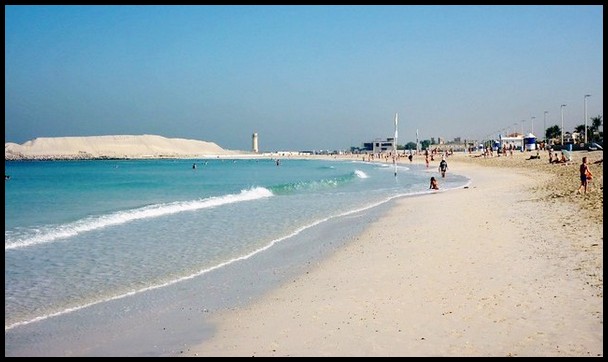
Bahrain Island (and its other islands) is flat and consists of mainly desert (92% of land area) with a coastline of 161 km / 100 miles and plenty of golden sand beaches. The highest point on the island is Jabal ad Dukhan at 134 M / 440 ft, situated on a central plateau. Only 2.6% of land is arable.
More than 330 species of birds have been identified in Bahrain, most of them migratory. There are also over 300 species of plants. In contrast, only 18 species of mammals live in Bahrain. The country has five protected areas.
Climate of Bahrain
Like all other countries on the Arabian Peninsula, the weather is extremely hot for most of the year. Temperatures reach up to 40-50 C / 110-125 F in summer and just slightly cooler in spring and autumn months. The seas around Bahrain are extremely shallow, which causes them to heat up quickly, then evaporate and cause high humidity.
However, in winter, from about December through February, the weather becomes ideal, with day time temperatures around 24-28 C / 75-82 C. Offering perpetually blue skies and sunshine, a slight breeze and drier rather than humid conditions, it’s a perfect climate.
Early mornings, evenings and over night temperatures are actually cool in winter, dipping to 17-20 C / mid 60s-70 F. With a breeze, even long sleeves may be needed.
In June and July, sandy winds blown in from Iraq, Saudi Arabia and Iran create huge sand storms, known as shamal winds.

Government of Bahrain
The Kingdom of Bahrain is a Semi-Constitutional Monarchy. It gained its independence from England in 1971, making it only 54 years old as of 2025. In 1971 Bahrain also joined the UN and the Arab League. Today, Bahrain maintains bi-lateral relations with 190 countries.
In 1999, Hamad bin Isa Al Khalifa became the Emir of Bahrain, as the result of a popular uprising lasting from 1994-2000. He greatly modernized Bahrain’s government and civil society by establishing elections for parliament, giving women the right to vote and releasing all political prisoners. Since then, some of these modernizations have slipped.
In 2002 he changed the country’s name from State of Bahrain to Kingdom of Bahrain and changed his title from Emir to King. He’s still king today. His son is the Crown Prince and Prime Minister. About half of government positions are filled by family members.

Population of Bahrain
The entire country has about 1.6 million people. For comparison, that’s about the same population as Phoenix, Arizona; Philadelphia, PA; or San Antonio, Texas. The official language is Arabic, but English is also widely spoken.
Rather amazingly, less than half the population are Bahraini nationals, about 47%. The remaining 53% are immigrants living and working in Bahrain. They are a hugely diverse people from 2000 ethnicities and dozens of countries.
In fact, one of the first things I noticed in Manama was the huge percentage of immigrants, particularly Asian, and more specifically Indian, Pakistani and Sri Lankan. But I also came across many Philipinos, Thais and Chinese.
That also means there are a lot of fantastic Asian restaurants, tea shops and bakeries! While there, I dined exclusively on Indian and Chinese cuisine from small independent restaurants in my neighborhoods. I even found a great Indian sweets shop, which was a real treat. Most restaurants were quite cheap, but a few were on the expensive side.
Nearly every morning I ate my favorite Indian breakfast: dosai with curries and chai tea. Yum! For lunches and dinners, I switched between Indian and Chinese meals.

Religion in Bahrain
Like all Middle Eastern countries (except Israel) Bahrain is predominantly Muslim, with 84% of the population practicing Islam. But the government officially allows freedom of religion and there are Hindu and Buddhist temples, Christian churches and even a Jewish synagogue!

Economy of Bahrain
Like most countries in the region, Bahrain has large quantities of natural oil and gas, leading to a very wealthy nation. The country’s big oil boom began in the early 1970s, soon after its independence as a sovereign nation. In the 1980s Bahrain became a financial and banking hub in the Middle East. The country is also historically known for its pearl industry.
Bahrain is a very wealthy country, with a GDP per capita in the top 25 wealthiest nations. In 2023 the per capita GDP was $63,500 US, putting it well above many European countries, UK, New Zealand and Canada.
However, compared to neighboring countries of Qatar, UAE and Saudi Arabia, Bahrain looks and feels quite poor, rather backwards and considerably less developed. In fact, I thought Bahrain was more comparable to several developing countries I’ve explored.

Manama
Bahrain’s capital city is Manama. That’s where most of the population lives and where most culture, museums, shopping, international restaurants and hotels are located. I spent my entire two-week visit in Manama.
I was quite surprised at how poor and down-trodden Manama looks, especially after visiting the super-wealthy, ultra-modern neighboring countries of Qatar and UAE. For one thing, Manama has just a smidgen of modern skyscrapers, shopping malls and other contemporary buildings.
Most of the city is filled with plain, older beige buildings of about 2-6 stories high. Streets are in bad condition, many of them actually unpaved within small neighborhoods! The city is all dusty, full of litter and piles of garbage and roaming raggedy street cats. Most of it looks more or less like a ghetto.
Manama is a vert surprising – and alarming – contrast to the uber-clean cities I experienced in Qatar, UAE and Oman.
Manama does at least have a few interesting attractions for visitors. Most impressive to me was historic Bahrain Fort, a Portuguese fortress set on the western outskirts of town. There are also a few museums, Al Fateh Grand Mosque, a traditional-style market (souq), a handful of stunning modern skyscrapers and a few huge modern shopping malls.

Brief History of Bahrain
Bahrain Island has an extremely long and complex history, with a whole slew of different tribes, cultures and countries having claimed the island over the millennia.
Ancient Bahrain Island was home to the Dilmun civilization from at least the bronze age, about 3000 BC. Even then, the island was an important part of international trade in the region. In later epochs, it was home to the Sumerians, Babylonians and Parthians. During the long Greek Empire period, the Greeks knew the island as an important cotton and pearl producer.
Islam arrived in Bahrain in the 600s AD and has remained the primary religion ever since. Over the following 1000 years, various Islamic tribes fought and ruled in the region, including Persians from Iran.
In 1592 the Portuguese invaded and took Bahrain from the Persians. They only managed to rule for 80 years, until 1602. During that time, they built several large stone fortresses. The ruins of that huge fort are now located at the western edge of Manama, called Bahrain Fort.
Persians regained control of Bahrain and ruled another 200 years, until the late 1700s, when a local Islamic tribe defeated the Persians. Throughout the 1700s several Islamic groups fought over control of Bahrain, mainly because of the lucrative pearl trade.
Eventually, the Al Khalifa family gained control in the late 1700s and mostly has remained in power ever since. Their dominance was due in large part to various treaties with the British from 1820. Britain was the main military force in the Persian Gulf and they agreed to recognize the Al Khalifa family as rulers and to protect Bahrain from adversaries.
Through the 1800s and early 1900s, Bahrain’s economy thrived. Discovery of oil and gas reserves in the 1920s accelerated their wealth. Not surprsisingly, Bahrainis grew discontent with British over-lords and various protests ensued through the mid 1900s. Eventually, as noted above, Bahrain gained independence from Britain in 1971.

My Impressions and best experiences in Bahrain
As I noted above, I was really surprised at how down-trodden and ghetto-like most of Manama appeared. It was a real contrast to neighboring UAE, Qatar and even Oman. It’s even more surprising when you realize how wealthy Bahrain is.
As a consequence, Bahrain was my least favorite country in the Middle East. I was infinitely more impressed with the unique modern architecture of Dubai and Qatar, as well as the cleanliness of neighboring countries.
My best experiences in Bahrain include a visit to the amazing Bahrain Fort, eating delicious Indian and Chinese food, and a site inspection of the astounding Four Seasons Hotel Bahrain. Otherwise, I was rather nonplussed with Manama.
===================================
You might also enjoy:
5 Reasons Why Dubai is a Great Budget Travel Destination
===================================